Ads for a new community starting (1981)

One of the sections of Bisexual Lives (1988) reprints an article from the London Bisexual Group's Bi-Monthly magazine with David Burkle saying:

For the three months before the London Bisexual Group's first meeting in September 1981 my phone number was used in small advertisements in Time Out and Gay News announcing the event.

When I went looking for those ads to see how I first heard about the group, I discovered that part of that had to be wrong: there no issues of Time Out were published in those months.

The listings magazine had its start in 1968. Inspired by the era's 'counter-culture', it had a principle that everyone got paid the same. When the founder and owner Tony Elliot wanted to change that in 1981 in order to pay some journalists more, a large majority of the staff went on strike in the spring.

The strike lasted several months, and no issues of Time Out were published until mid-September, a couple of weeks after the LBG's first meeting.

But that didn't mean that London went without a listings magazine over the summer! Ejected from the offices they occupied, the strikers used their printing connections to produce Not Time Out, quickly renamed Not… after Elliot brought an action for 'passing off'.

The first couple of issues were tiny (at least in page count – all the issues used newspaper presses and were roughly tabloid sized newsprint compared to the smaller glossy paper used for Time Out) and focused on the strikers' case, but soon grew into a listings magazine. Its coverage was patchy, but did in its 15th issue, covering 28th August to 3rd September..

.. on its 'Agitprop' page..

.. was this:

Bisexual Men and Women. First of regular weekly social meetings. 8.30 at Heaven disco, The Arches, Villiers St. WC2. Details: Louise [phone number] (days) or David [phone number] (eves).

The 314 Grays Inn Road address that Not… used was then the home of the National Union of Journalists and was later the headquarters of the Terrence Higgins Trust…

By that point at the end of August 1981, the failure to reach any agreement with Elliot meant the strikers had decided to start their own listings magazine, City Limits. Elliot hired a bunch of new staff hired at those different rates and Time Out resumed publication.. just too late to feature the start of a new community.

The first appearance in Time Out I can find was in October 1981…

Women in Revolt!

.. is the title of a touring exhibition from the Tate, with the subtitle 'Art and activism in the UK 1970-1990'.

I saw it in August 2024 at Modern Two, part of Scotland's National Galleries in Edinburgh.

The final room, "No such thing as society",[1]".. and who is society? There is no such thing!", Margaret Thatcher talking to Woman's Own magazine, 1988 contains a large chunk of the queer stuff.

In the online copy of the exhibition guide including the captions for all of the pictures, the word 'bisexual' does not appear once. There are ten uses of 'LGBT's/'LGBTQ..'s seven of which aren't in URLs or collection titles, twenty eight uses of 'gay', and forty two uses of 'lesbian'.

But the room does have a couple of photos where I went 'I recognise them from the bi community!'. Pam Isherwood's Pride march from 1985:
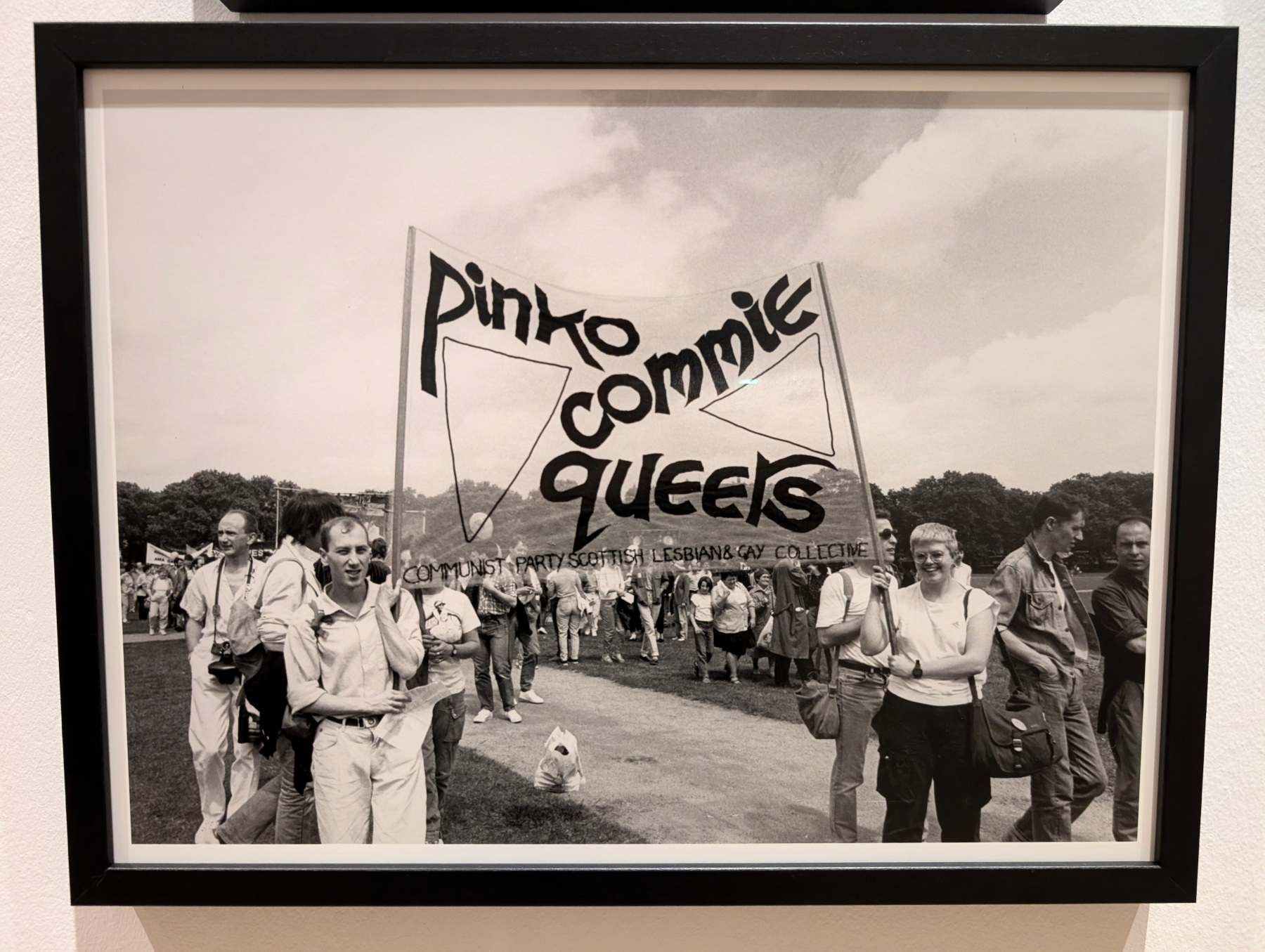
Stephen Holdsworth and Kate Fearnley holding a 'Pinko Commie Queers' banner at 1985's Pride event in London

Holding the banner on the right of the photo is Kate Fearnley
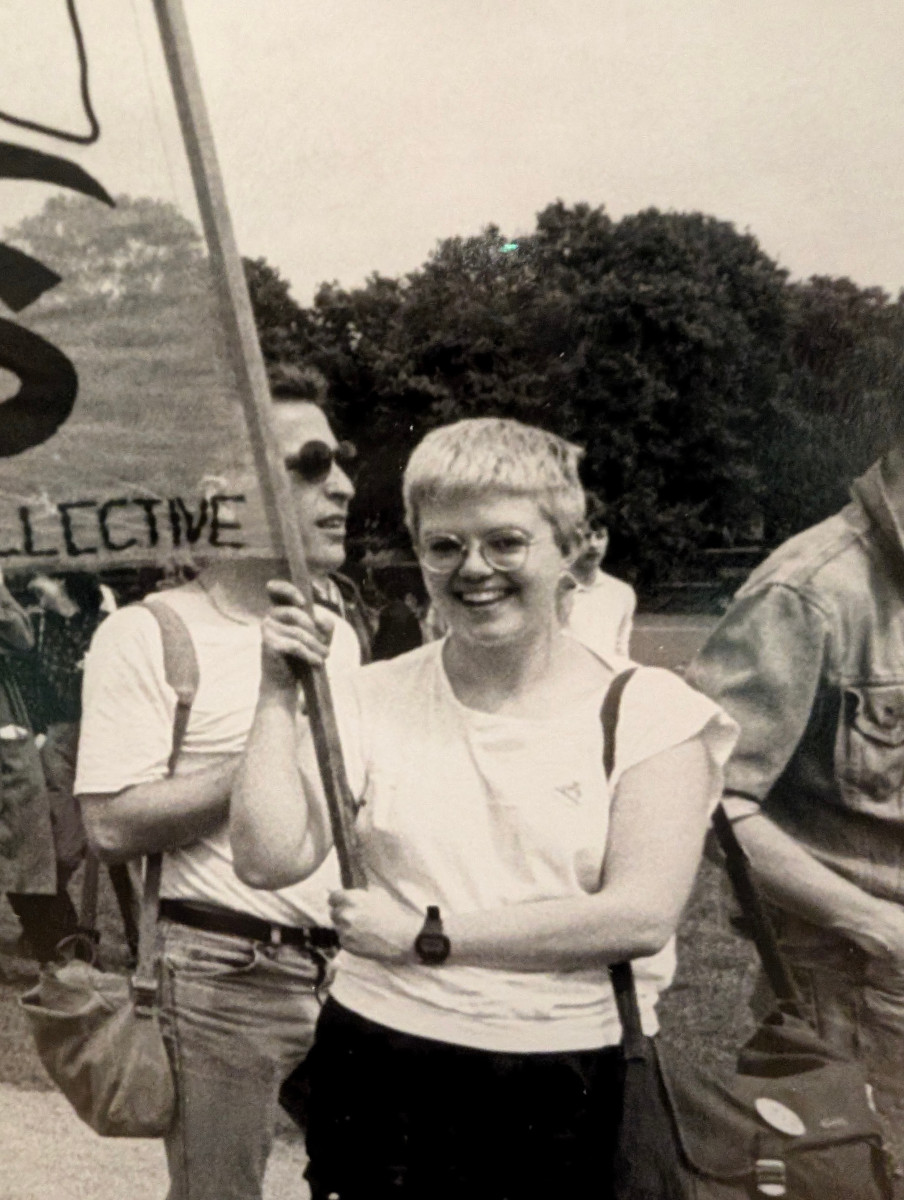
Pinko Commie (bisexual) Queer Kate

The other maker of the banner, Stephen Holdsworth, is on the left.

Apparently, there are photos of Mark Ashton, of 'Lesbians and Gays Support the Miners' fame amongst other causes, holding the banner but this is one of very few showing Kate holding it – and a shot of two men holding a banner probably wouldn't have made it into the exhibition.

In Edinburgh, where Kate has lived and worked for decades, the picture is low down by the floor to the point that you have to bend down to see it, but the Tate's guide reckons it was on the top row there.

The other photo is from Dell LaGrace Volcano, On The Way There, taken on the day of London's Pride event in 1988:

The person in the middle..
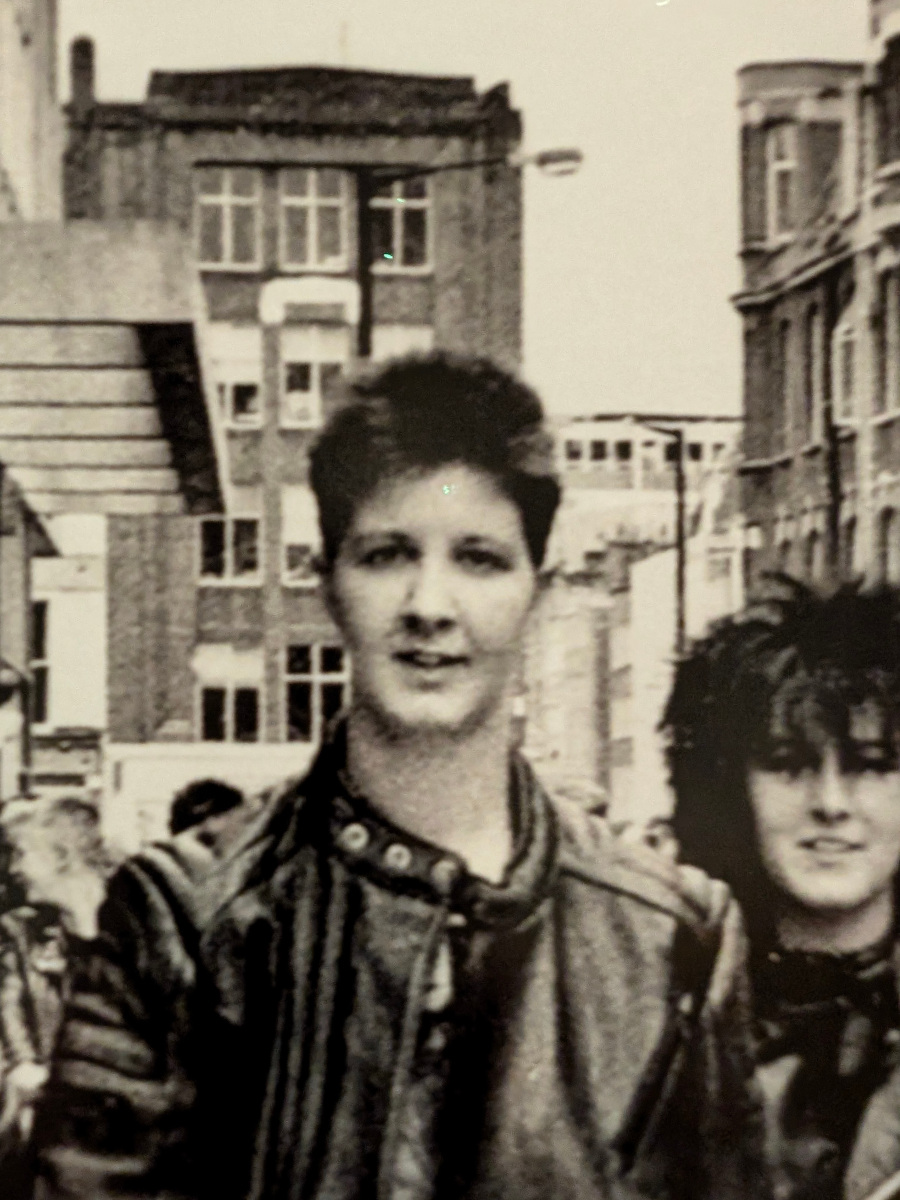
Sarah

.. named as 'Sarah' on the label is, unless I am very much mistaken, this Sarah, also seen in the Double Trouble article a couple of years earlier.

Notes

Notes
1".. and who is society? There is no such thing!", Margaret Thatcher talking to Woman's Own magazine, 1988

Double Trouble – The Guardian, 18th February 1986

Published in the paper's 'Open Space' section, this was my reintroduction to the UK's bi community.

At the start of October 1981, I had just started as a new student at Reading University . Browsing – rather than buying! – a copy of London listings magazine Time Out[1]Interestingly, writing in 1986 David Burkle thought he'd used Time Out to publicise the group in the months before it started. But looking for the relevant copy in a library, it turns out that no … Continue reading in the Student Union's shop, I noticed that there was a meeting of the London Bisexual Group at gay nightclub 'Heaven' on Tuesday 13th. Read more

Notes

Notes
1Interestingly, writing in 1986 David Burkle thought he'd used Time Out to publicise the group in the months before it started. But looking for the relevant copy in a library, it turns out that no issues of Time Out were published in the four months before mid-September that year, thanks to a strike over the magazine abandoning its 'equal pay for everyone' ethos. Some staff quit to start City Limits and keep those principles, but their first issue was in October. It also turns out that Time Out didn't have a 'lesbian and gay' section until after then either.

The 'Chronos being Chronos' bi-erasing 1998 Pride questionnaire

Chronos was one of the many names of the company that published lesbian and gay newspapers and magazines such as Boyz and, between buying it from its original founders in the early 90s and later selling it to the 'publishers of Gay Times and owners of an adult shop' Millivres in 2005, the Pink Paper.

After the failure of Pride Events UK, the bunch of chancers that tried to run a commercial Pride event in London in July 1998, Chronos's Kelvin Sollis and possibly its co-owner, David Brindle, did the same maths that PEUK had done and discovered that running a commercial Pride event could be very profitable. Read more

The design for the bi 'tent' at London's Lesbian and Gay Pride 1994 and 1995 festivals

As mentioned in my post on what lead up to London's Pride event changing its name to 'Lesbian, Gay, Bisexual, and Transgender Pride' in 1996, until that happened, the London Bisexual Group used to pay around £100 for a stall in the festival's "marketplace".

In 1993, the minutes of the LBG executive suggest that the group paid for two 2m x 2m stall spaces at the festival in Brockwell Park. At the moment, I cannot if a supplied table was supplied or if we took a pair of folding table ourselves.

In 1994, the cost of what we wanted – again in Brockwell Park – was going to be £150, but this was found from another source..[1]The minutes call it a 'grant', but don't say who it was from. Read more

Notes

Notes
1The minutes call it a 'grant', but don't say who it was from.